
Third-Party Pharma Manufacturing Cost in India: A Complete Guide

Third-Party Manufacturing vs Loan Licence: Which Pharma Manufacturing Model Is Right for Your Business?
September 24, 2026Third-Party Pharma Manufacturing Cost in India | Dokcare Lifesciences
The pharmaceutical industry in India has experienced exponential growth over the past few decades, evolving into a global hub for high-quality, cost-effective medicines. As the demand for healthcare products continues to rise both domestically and internationally, pharmaceutical companies, PCD pharma franchise owners, distributors, and entrepreneurs are increasingly turning to contract and outsourcing models. Understanding the Third-Party Pharma Manufacturing Cost in India is a critical step for any business looking to launch or expand its product lineup without investing heavily in establishing personal manufacturing units.
Outsourcing production allows businesses to concentrate on their core strengths—marketing, sales, distribution, and brand building—while leveraging the infrastructure, technical expertise, and production capabilities of established manufacturers. Partnering with experienced industry leaders like Dokcare Lifesciences helps companies navigate the operational complexities of pharmaceutical production smoothly. However, to build a sustainable business model, it is vital to understand how manufacturing costs are structured, what variables influence per-unit pricing, and how to optimize expenses without compromising on quality standards.
What Is Third-Party Pharma Manufacturing?
Third-party pharma manufacturing—often referred to as contract manufacturing—is a strategic arrangement where a pharmaceutical company outsources the production of its products to a specialized manufacturing unit.
Under this model, the manufacturing partner formulates, processes, tests, and packages the products according to the client’s specifications, brand name, and design requirements. This allows pharmaceutical businesses to focus their core resources on marketing, distribution, sales, and brand building, while leveraging the technical expertise and infrastructure of established manufacturers.
What Is the Average Third-Party Pharma Manufacturing Cost in India?
There is no single fixed figure for the third-party pharma manufacturing cost in India. Manufacturing expenses vary significantly depending on what is being produced, the volume requested, and the specific standards required for the batch.
Rather than relying on fixed figures, pharmaceutical companies evaluate production costs based on the total cost of goods sold (COGS), which incorporates raw materials, processing charges, packaging, testing, and taxes. Understanding these cost drivers helps businesses forecast expenses accurately without falling for misleading quote estimations.
Major Factors Affecting Third-Party Pharma Manufacturing Cost in India
Several operational, technical, and commercial variables determine the overall third-party pharma manufacturing cost in India.
1. Type of Pharmaceutical Product and Dosage Form
The formulation type plays a primary role in determining production expenses. Simple oral solid dosages generally require lower operational overhead compared to specialized sterile preparations like injectables or softgel capsules.
2. Raw Material and Active Pharmaceutical Ingredient (API) Costs
The cost of Active Pharmaceutical Ingredients (APIs) and excipients directly impacts the overall third-party pharma manufacturing cost in India. High-purity APIs, imported raw materials, or scarce active compounds naturally increase the batch cost.
3. Formulation and Composition Complexity
Complex formulations, sustained-release tablets, combination drugs, and specialized nutritional blends require precise equipment, additional testing, and specialized processing conditions, which increase manufacturing expenses.
4. Production Order Quantity
Order volume directly influences per-unit expenses. Larger batch sizes lower the per-unit third-party pharma manufacturing cost in India due to operational efficiency and bulk material purchasing power.
5. Packaging and Labeling Requirements
Packaging is a key component of the total price. Options range from standard PVC blister packing to premium aluminum-aluminum (Alu-Alu) packaging, glass bottles, or customized outer cartons.
6. Quality Control and Analytical Testing
Every pharmaceutical batch must undergo rigorous laboratory testing—including raw material assay, stability testing, and final product quality checks—to meet safety standards.
7. Regulatory and Documentation Expenses
Compiling product dossiers, obtaining government permissions, batch manufacturing records (BMR), and Certificate of Analysis (COA) compliance add administrative and technical costs to the production process.
8. Logistics and Transportation
Shipping finished goods from the manufacturing plant to the client’s warehouse involves freight charges, transit insurance, and temperature-controlled storage if required.
Cost Comparison by Pharmaceutical Dosage Form
To better understand how dosage forms influence the third-party pharma manufacturing cost in India, let us compare the general cost factors across common product types:
- Tablets (Uncoated, Film-Coated, Enteric-Coated): Generally offer a cost-effective manufacturing route. Uncoated tablets are the least expensive, while enteric-coated or sustained-release variants increase processing and raw material costs.
- Hard Gelatin and Softgel Capsules: Hard gelatin capsules are relatively economical. Softgels, however, carry a higher third-party pharma manufacturing cost in India due to specialized gelatin processing machinery and precise liquid filling controls.
- Oral Syrups and Suspensions: Expenses depend heavily on bottle types (PET vs. Glass), cap seals, measuring cups, and sugar or sugar-free base compositions.
- Dry Syrups: Require moisture-resistant packaging materials and high-grade powdered active ingredients, impacting raw material and packaging costs.
- Injectables (Ampoules and Vials): Sterilisation demands, aseptic cleanroom environments, specialized glass packaging, and strict quality compliance make injectables one of the higher-cost categories.
- Ointments, Creams, and Gels: Production costs depend on base emulsions, active drug dispersion, and laminate tube packaging choices.
How Order Quantity Affects Manufacturing Cost
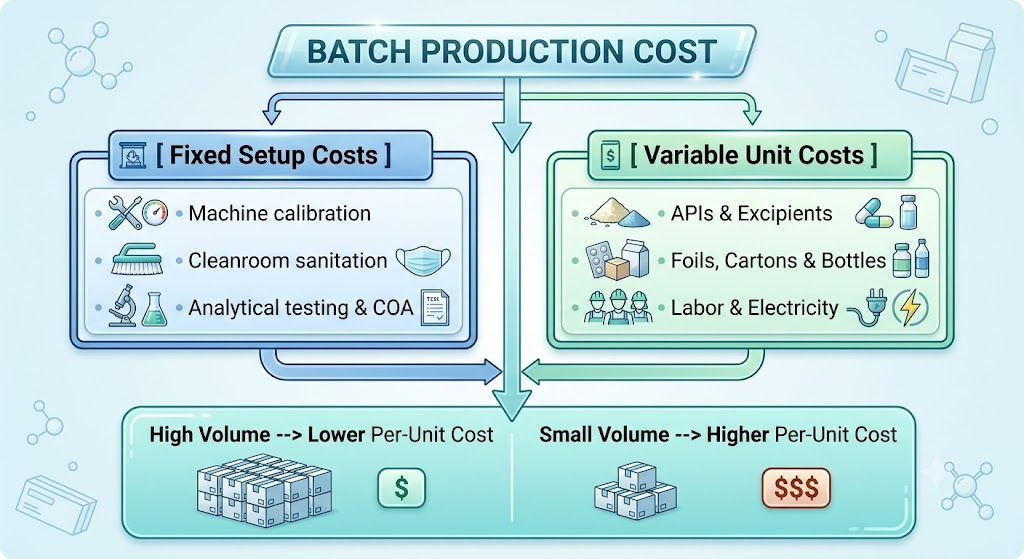
Order volume is one of the strongest levers in controlling the third-party pharma manufacturing cost in India. Manufacturing facilities incur fixed setup costs for every batch, including machine cleaning, calibration, room sanitation, line clearance, and analytical testing.
When you order larger minimum order quantities (MOQ):
- Fixed operational costs are distributed over more units, reducing the per-tablet, per-capsule, or per-bottle expense.
- Manufacturers can source raw materials and packaging supplies in bulk, securing lower rates from suppliers.
- Production lines run continuously without frequent downtime for machinery changeovers.
For small batches, fixed setup fees represent a larger proportion of the invoice, resulting in a higher per-unit third-party pharma manufacturing cost in India.
Packaging and Branding Costs
Packaging serves a dual purpose: protecting the drug’s stability and creating brand identity in the marketplace. Packaging options significantly affect the third-party pharma manufacturing cost in India.
Common Packaging Breakdown
- Primary Packaging: Direct contact materials such as Alu-Alu blister foil, PVC/PVDC film, HDPE bottles, or glass vials. Alu-Alu offers superior moisture and light protection but comes at a higher price than standard PVC blister packing.
- Secondary Packaging: Outer cartons, catch covers, and metallic foils. Custom finishes like UV embossing, foil stamping, or specialized textures increase branding appeal along with unit cost.
- Tertiary Packaging: Corrugated boxes, shrink wrap, and shipping cartons designed to protect products during transit.
Working with an experienced partner like Dokcare Lifesciences ensures you receive guidance on selecting packaging materials that balance product protection, regulatory standards, and cost-efficiency.
Additional Costs to Consider
When budgeting your overall third-party pharma manufacturing cost in India, ensure you account for these indirect and initial setup expenses:
- Artwork and Design Fees: Developing drug brand design, logo placement, packaging layout, and barcode integration.
- Drug Inventory and Storage: Holding finished stock in climate-controlled environments prior to dispatch.
- Goods and Services Tax (GST): Applicable government tax rates on pharma products and manufacturing services must be calculated into cash flow planning.
- Product Re-testing Charges: Optional third-party laboratory verification for specialized market entries.
Why Choose a Reliable Third-Party Pharma Manufacturing Company?
While optimizing costs is vital, selecting a partner based solely on the lowest quote can lead to compromised drug efficacy, delayed deliveries, or regulatory compliance issues. Partnering with a reliable manufacturer ensures:
- Consistent Product Quality: Adherence to strict quality management systems across every batch.
- Transparent Cost Structures: Clear quotation without hidden charges for testing, processing, or documentation.
- Timely Delivery Timelines: Dependable schedule management to avoid market out-of-stock scenarios.
- Regulatory Peace of Mind: Comprehensive documentation support including COA, BMR, and product technical sheets.
Third-Party Pharma Manufacturing with Dokcare Lifesciences
Navigating production requirements requires a manufacturing partner that prioritizes quality, cost transparency, and seamless communication. Dokcare Lifesciences offers comprehensive third-party pharma manufacturing support designed to meet the diverse needs of pharmaceutical companies, distributors, and franchise owners.
When you work with Dokcare Lifesciences, you gain access to:
- A diverse portfolio of dosage forms, including oral solids, liquids, and topical preparations.
- Professional assistance in selecting suitable formulations and cost-effective packaging solutions.
- Strict adherence to batch quality controls, analytical verification, and standardized packaging.
- Transparent communication regarding batch timelines, documentation support, and inventory dispatch.
By managing backend production processes smoothly, Dokcare Lifesciences enables your business to focus on expanding sales networks and building market presence while keeping your third-party pharma manufacturing cost in India manageable and competitive.
Tips to Reduce Third-Party Pharma Manufacturing Costs
If you want to optimize your production budget without compromising product quality, consider these practical strategies:
- Optimize Order Volumes: Align your order sizes with supplier MOQs to unlock lower per-unit production costs.
- Standardize Packaging Formats: Choose standard blister sizes, bottle dimensions, and box formats to minimize custom tooling expenses.
- Plan Production Ahead: Advance planning avoids urgent rush charges, expedited freight costs, and raw material scarcity premiums.
- Finalize Packaging Artwork Early: Prevent re-printing costs by carefully checking all text, regulatory warnings, and designs before approving master prints.
- Consolidate Product Lines: Manufacturing multiple formulations under one partner like Dokcare Lifesciences helps streamline freight logistics and administrative overhead.
How to Choose the Right Third-Party Pharma Manufacturer in India
Evaluating potential manufacturing partners requires a structured approach. Use this checklist when selecting a provider to keep your third-party pharma manufacturing cost in India reasonable while maintaining high standards:
- [ ] Manufacturing Quality Standards: Verify that the facility maintains rigorous quality control procedures and testing practices.
- [ ] Product Portfolio: Ensure the company produces the exact dosage forms and formulations your market requires.
- [ ] Pricing Transparency: Request itemized breakdowns covering raw materials, processing, packaging, and testing.
- [ ] Production Lead Times: Confirm standard turnaround times from order placement to dispatch.
- [ ] Packaging Options: Evaluate available packaging styles, material choices, and customization capabilities.
- [ ] Documentation Support: Check if they supply complete batch documentation, analytical reports, and certificates.
- [ ] Industry Reputation: Assess the manufacturer’s track record for reliability, communication, and client support.
Conclusion
Understanding the third-party pharma manufacturing cost in India involves evaluating a combination of factors, including dosage forms, raw material costs, order quantities, packaging styles, and testing requirements. While controlling expenses is essential for commercial viability, long-term success in the pharmaceutical market depends on product safety, quality consistency, and reliable delivery schedules.
By partnering with an established company like Dokcare Lifesciences, businesses can balance affordability with quality standards. Thorough planning, clear packaging choices, and realistic batch sizing will help you optimize your third-party pharma manufacturing cost in India while establishing a successful pharma brand.
Frequently Asked Questions (FAQs)
1. What is the typical minimum order quantity (MOQ) for third-party pharma manufacturing in India?
MOQs depend on the dosage form and manufacturer policies. Tablets and capsules generally require larger minimum order quantities (e.g., 30,000 to 50,000 units), while liquid syrups or injectables may have different batch size thresholds.
2. How does packaging choice affect the third-party pharma manufacturing cost in India?
Packaging choices directly impact costs. Premium options like Alu-Alu packing, customized glass bottles, or metallic cartons carry higher material and processing expenses compared to standard PVC blister packs or plain PET bottles.
3. Are quality testing fees included in the manufacturing quotation?
In most cases, standard batch testing and Certificate of Analysis (COA) documentation are factored into the overall quotation. However, specialized stability studies or advanced analytical tests may be billed as separate requirements.
4. Can new pharma businesses start with small manufacturing batches?
Yes, many companies start with lower batch volumes to test market demand. However, smaller orders yield a higher per-unit third-party pharma manufacturing cost in India because fixed setup and machine calibration expenses are divided over fewer products.
5. What documentation is required to start contract manufacturing with a partner like Dokcare Lifesciences?
To initiate third-party manufacturing, businesses typically need a valid Wholesale Drug License (WDL), GST registration, registered brand name/trademark details, and approved packaging artwork layouts.
6. How long does the third-party pharma manufacturing process take from order to delivery?
Initial orders generally take 30 to 45 days, as time is needed for artwork design, plate making, packaging approval, and initial testing. Repeat orders are usually completed faster, often within 20 to 30 days.
