Third-Party Manufacturing vs Loan Licence: Which Pharma Manufacturing Model Is Right for Your Business?

Revised Schedule M: A Comprehensive Guide to Compliance and Quality Excellence in Pharmaceutical Manufacturing
September 23, 2026
Third-Party Pharma Manufacturing Cost in India: A Complete Guide
September 24, 2026Third-Party Manufacturing vs Loan Licence | Dokcare Lifesciences
Selecting the most suitable production strategy is one of the most critical decisions facing pharmaceutical companies, distributors, entrepreneurs, and healthcare brands today. The structure you choose directly impacts your upfront capital requirements, regulatory responsibilities, operational agility, and long-term profit margins. In the Indian pharmaceutical industry, two contract manufacturing models dominate the commercial landscape: third-party pharma manufacturing and loan licence manufacturing. While both models allow companies to market products without constructing their own manufacturing facilities, they operate under fundamentally different regulatory frameworks, financial structures, and operational dynamics.
Understanding the nuances of Third-Party Manufacturing vs Loan Licence arrangements is vital before committing resources. Selecting the wrong model can lead to unnecessary regulatory friction, unexpected capital drains, or limited control over your product pipeline. Partnering with a reliable manufacturing expert like Dokcare Lifesciences can simplify these complexities, but this comprehensive guide breaks down how both manufacturing pathways operate, compares their core operational differences, evaluates financial considerations, and helps you determine which model aligns best with your strategic goals.
What Is Third-Party Pharmaceutical Manufacturing?
Third-party manufacturing (often referred to as contract manufacturing) is an arrangement where a company hires an external pharma manufacturing company in India to produce medicines under its own brand name.
In a typical third-party pharma manufacturing relationship, the brand owner (marketing company) provides the formulation specifications, packaging designs, and brand details to an established third-party manufacturing company. The contract manufacturer then handles the entire production process—from raw material procurement and active pharmaceutical ingredient (API) sourcing to formulation, batch testing, quality assurance, and finished product packaging.
Core Dynamics of the Third-Party Model
- Manufacturing Responsibility: Fully managed by the third-party manufacturing company, which holds the primary Drug Licence and manufacturing approvals for the facility.
- Brand Marketing Responsibility: Handled exclusively by the marketing partner or distributor.
- Regulatory Ownership: The manufacturer’s facility licence covers the production process, while the marketing company holds the trade name or trademark rights.
Why Companies Choose Third-Party Manufacturing
Pharmaceutical businesses frequently opt for third-party manufacturing because it significantly lowers barriers to market entry.Entrepreneurs, growing PCD pharma franchise operators, and established brand owners can launch comprehensive product portfolios without making massive capital investments in real estate, specialized machinery, cleanrooms, or manufacturing staff.Experienced manufacturing partners, such as Dokcare Lifesciences, offer reliable pharmaceutical manufacturing services across diverse therapeutic segments—including oral solids, liquids, injectables, and topicals—allowing brand owners to focus entirely on marketing, sales, and supply chain distribution.
What Is a Loan Licence in Pharmaceutical Manufacturing?
A loan licence in pharmaceutical industry operations is a specialized regulatory framework that permits a business to manufacture drugs using the premises, equipment, and utility infrastructure of another licensed manufacturer.
Unlike general outsourcing, loan licence pharma manufacturing involves a dual-entity regulatory relationship. The applicant company applies for a distinct “Loan Licence” from the relevant state licensing authority or drug control organization. Under this arrangement, the facility owner “loans” its manufacturing infrastructure to the applicant, but the loan licensee maintains direct legal, regulatory, and quality control responsibility for the batches produced under that licence.
How Loan Licence Manufacturing Differs from Outsourcing
In a standard contract manufacturing arrangement, you purchase finished goods from a vendor. In loan licence manufacturing, your company acts as the official manufacturer on record using another firm’s facility. You bear direct accountability for batch quality, raw material testing, analytical testing, regulatory compliance, and official documentation maintained at the site.
Regulatory Note: Specific statutory provisions, documentation requirements, and licensing fees for loan licences are governed by applicable national and state drug regulations (such as the Drugs and Cosmetics Act and Rules in India). Businesses must verify exact application workflows and compliance conditions directly with the relevant Drug Control Authority before proceeding.
Third-Party Manufacturing vs Loan Licence: Key Differences
To select the right pharma manufacturing business model, you must evaluate how both structures handle everyday operational and regulatory duties. Below is a detailed comparison examining Third-Party Manufacturing vs Loan Licence across core business criteria.
Comparison Table: Third-Party Manufacturing vs Loan Licence
| Evaluation Criteria | Third-Party Manufacturing Model | Loan Licence Manufacturing Model |
| Manufacturing Ownership | Managed fully by the vendor facility. | Shared; licensee utilizes facility capacity under its own licence. |
| Primary Regulatory Responsibility | Vendor holds facility & production licenses. | Marketing company holds a dedicated Loan Licence. |
| Capital & Infrastructure Requirements | Minimal upfront cost; no facility investment. | Moderate setup cost; requires regulatory fees & compliance oversight. |
| Operational Control | Vendor oversees production schedules & batch releases. | Marketing company maintains direct oversight over batch manufacturing. |
| Quality Control & Testing | Handled by vendor’s internal QA/QC laboratories. | Shared or licensee-supervised testing & batch testing documentation. |
| Documentation Workload | Low; handled primarily by the contract manufacturer. | High; requires official batch manufacturing records (BMR) & testing logs. |
| Production Scalability | High; easy to switch or add manufacturing plants. | Moderate; bound to specific premises approved in the loan licence. |
| Business Flexibility | High agility for testing new product categories. | Lower short-term agility due to site-specific licensing steps. |
| Risk & Legal Exposure | Facility risk lies with manufacturer; brand risk with marketer. | Higher direct compliance and batch quality accountability. |
Third-Party Manufacturing vs Loan Licence: Cost Considerations
Evaluating the financial impact of Third-Party Manufacturing vs Loan Licence requires looking beyond basic per-unit production rates. Both models carry unique cost profiles shaped by product formulation, order volumes, packaging customization, and analytical testing standards.
Financial Profile of Third-Party Manufacturing
- Capital Outlay:Exceptionally low initial investment. You pay primarily for minimum order quantities (MOQs), inventory packaging, and basic administrative setup.
- Unit Economics: The unit cost includes the manufacturer’s operational margin, raw material expenses, and processing fees.
- Financial Flexibility: Working capital remains fluid because funds are tied directly to finished stock inventory rather than regulatory maintenance or idle plant overhead.
Financial Profile of Loan Licence Manufacturing
- Capital Outlay: Moderate initial setup expenses. Costs include state regulatory licensing application fees, site audit inspections, legal agreements, and potential retainers for facility time.
- Unit Economics: Per-unit conversion costs can be lower at high production volumes, as the manufacturing facility charges mainly for machine hours, utility usage, labor, and space allocation.
- Ongoing Overhead: Requires ongoing expenditure for maintaining active licensing, batch audit logs, independent QA/QC verification, and regulatory compliance updates.
Overall expenditure under both models varies significantly depending on specific product lines, specialized dosage forms (e.g., sterile injectables vs. oral tablets), packaging materials, and batch testing protocols.
Advantages of Third-Party Manufacturing
The rapid expansion of third-party pharma manufacturing across India highlights its distinct commercial benefits for modern healthcare companies.
- Lower Infrastructure Investment: Eliminates the need to acquire land, construct WHO–GMP-compliant cleanrooms, or purchase heavy processing machinery.
- Access to Advanced Technical Expertise: Partners leverage the specialized technical skills, chemical formulation capabilities, and sophisticated automated machinery of established players like Dokcare Lifesciences.
- Reduced Operational Complexity:Eliminates daily plant management challenges, machine maintenance, labor management, and utility monitoring.
- Seamless Scalability: Enables companies to instantly scale up production volumes or introduce new product lines simply by placing expanded orders with their manufacturing partner.
- Clear Focus on Sales & Marketing: Allows leadership teams to direct their capital, energy, and resources toward brand building, healthcare provider engagement, and distribution expansion.
Advantages of a Loan Licence Model
While third-party manufacturing offers speed and simplicity, the loan licence in pharmaceutical industry framework provides strategic advantages for specific business models:
- Direct Operational Involvement: Allows companies to supervise batch processing, raw material selection, and technical formulation directly on the factory floor.
- Enhanced Process Control: Provides greater control over proprietary manufacturing steps, custom batch scheduling, and specialized quality protocols.
- Dedicated Facility Utilization: Enables businesses to leverage an established, regulatory-approved facility without absorbing the long-term debt or real estate risks of facility ownership.
- Long-Term Brand Equity: Establishing a distinct manufacturing licence buildable over time can add intrinsic enterprise value for specialized pharmaceutical research firms or established mid-tier companies.
Third-Party Manufacturing vs Loan Licence: Which Model Is Suitable for Different Types of Pharma Businesses?
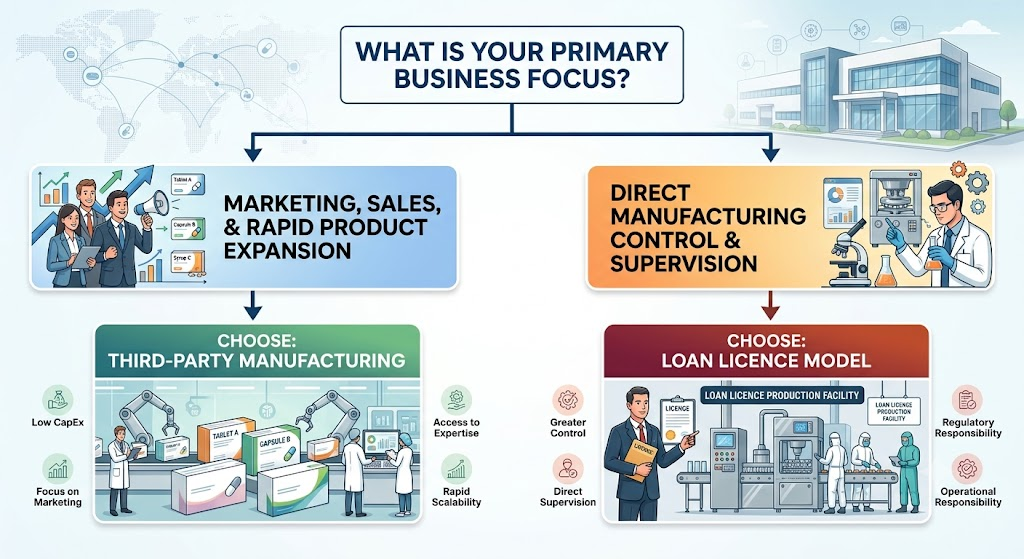
Choosing between Third-Party Manufacturing vs Loan Licence depends on your organization’s internal capabilities, financial resources, and corporate roadmap.
Ideal Candidates for Third-Party Manufacturing
- Pharma Startups & Entrepreneurs: Businesses seeking fast market entry with minimal initial capital outlay.
- PCD Franchise Holders & Distributors: Expanding companies looking to launch proprietary product lines alongside distribution networks.
- Virtual Pharma Companies: Organizations structured entirely around marketing, clinical research, and sales rather than physical operations.
- Brands Expanding Product Lines:Established firms entering new therapeutic spaces (e.g., launching a new dermatology or pediatric line) without expanding existing facilities.
Ideal Candidates for a Loan Licence Model
- Established Pharma Marketing Companies: Firms with dedicated in-house technical teams, quality managers, and regulatory specialists.
- R&D-Driven Formulators: Companies producing specialized or complex proprietary formulations that require strict, hands-on batch oversight.
- Mid-Sized Pharma Enterprises: Businesses transitioning toward owning direct production assets in the future that want an intermediate step to build manufacturing expertise.
Role of a Reliable Pharma Manufacturing Partner
Regardless of whether you choose a contract manufacturing arrangement or a loan licence framework, your success depends heavily on the capability and reliability of your manufacturing partner. A weak manufacturing partner can lead to batch delays, quality discrepancies, and regulatory complications that harm your brand reputation.
When evaluating potential pharma manufacturing options in India, assess candidates against the following standards:
- Quality Assurance & Standards:Ensure the manufacturing facility operates under modern quality management systems and strictly adheres to relevant regulatory guidelines, such as WHO-GMP compliance standards.
- Infrastructure & Facility Standards:Verify that the plant features modern automated machinery, climate-controlled storage, and advanced testing laboratories.
- Product Range & Capabilities:Confirm that the partner offers production support across your targeted dosage forms—including tablets, capsules, liquid syrups, dry powders, and specialized injectables.
- Regulatory & Documentation Support: Choose a partner capable of supplying full batch manufacturing records, Certificate of Analysis (COA) documents, and regulatory filings promptly.
- Supply Chain Reliability:Consistent delivery timelines and reliable raw material sourcing prevent inventory stockouts across your retail and wholesale networks.
Companies like Dokcare Lifesciences support growing pharmaceutical brands by offering high-quality third-party pharma manufacturing services and flexible manufacturing solutions tailored to modern market requirements. By pairing advanced manufacturing capabilities with strict quality standards, reliable partners help pharma businesses maintain product safety and market consistency.
Third-Party Manufacturing vs Loan Licence: Decision Checklist
Use this concise decision checklist to evaluate which pharma manufacturing business model aligns with your operational profile:
Favored Table: Third-Party Manufacturing vs Loan Licence
| Business Evaluation Criteria | Third-Party Manufacturing | Loan Licence Model |
| Capital Allocation | Favored if your primary budget is focused on marketing, sales, and brand promotion. | Favored if you have capital reserved for regulatory licensing, site audits, and compliance overhead. |
| In-House Technical Expertise | Favored if you prefer the vendor’s team to handle production compliance, QA/QC, and technical audits. | Favored if you employ dedicated in-house quality assurance personnel and regulatory managers to oversee production. |
| Speed to Market | Favored if you need to launch products rapidly to seize immediate market opportunities. | Favored if your business can accommodate longer lead times required for facility-specific regulatory approvals. |
| Operational Focus | Favored if your core strength lies in doctor detailing, distribution networks, and brand building. | Favored if your core focus includes hands-on manufacturing supervision and direct operational involvement. |
| Portfolio Diversity | Favored if you are launching diverse formulations across multiple therapeutic segments simultaneously. | Favored if you are focusing on specialized, proprietary formulations bound to specific approved facilities. |
Conclusion
When weighing Third-Party Manufacturing vs Loan Licence pathways, there is no single “correct” choice for every business. Both pathways serve vital functions within the modern pharmaceutical ecosystem.
Third-party manufacturing offers unmatched speed, operational agility, lower capital risk, and Freedom from day-to-day plant management—making it the preferred path for startups, growing distributors, and marketing-focused brands. Conversely, a loan licence model provides greater hands-on involvement, operational control, and regulatory presence for established firms equipped to manage technical oversight directly.
Carefully assess your capital resources, technical expertise, regulatory capabilities, and long-term business goals before finalizing your decision. By aligning with an experienced, quality-focused manufacturing partner like Dokcare Lifesciences, you can establish a resilient supply chain, ensure consistent product quality, and build a scalable foundation for sustainable business growth.
Frequently Asked Questions (FAQs)
Q1: What is the primary difference between third-party manufacturing and a loan licence?
In third-party manufacturing, the contract manufacturing company holds the primary drug licence, manages facility operations, and handles complete production under its own registration. Under a loan licence model, your company applies for a specific licence to use another manufacturer’s premises, making you directly responsible for regulatory compliance, batch records, and quality oversight.
Q2: Which model requires a lower upfront investment for a pharma startup?
Third-party pharmaceutical manufacturing generally requires significantly lower upfront capital. Since you do not need to apply for facility-specific drug licences or maintain regulatory compliance at the manufacturing site, your primary expenses are limited to batch orders, packaging designs, and product distribution.
Q3: Can a company switch from third-party manufacturing to a loan licence model later?
Yes. Many pharmaceutical businesses start with third-party manufacturing to test market demand and build capital without heavy operational overhead. Once their brand portfolio matures and they build in-house technical and regulatory teams, they may transition to a loan licence model or establish their own manufacturing facility.
Q4: Who is responsible for quality testing and batch releases under a loan licence?
Under a loan licence arrangement, the loan licensee (your company) shares direct accountability for batch quality, testing protocols, and compliance documentation. While you utilize the host facility’s equipment and testing labs, your technical staff or authorized signatories must verify that every batch complies with statutory quality standards before market release.
Q5: How do I choose the right pharma manufacturing partner in India?
When evaluating manufacturing partners like Dokcare Lifesciences, look for WHO-GMP compliance, robust testing infrastructure, reliable supply chain timelines, and extensive product capabilities across your required dosage forms (such as tablets, capsules, or injectables). Clear communication and regulatory support are equally essential for smooth operations.
